
The Haematex Newsletter
April 2026
Welcome to the Haematex Newsletter - April 2026
CLOTS IN SPACE
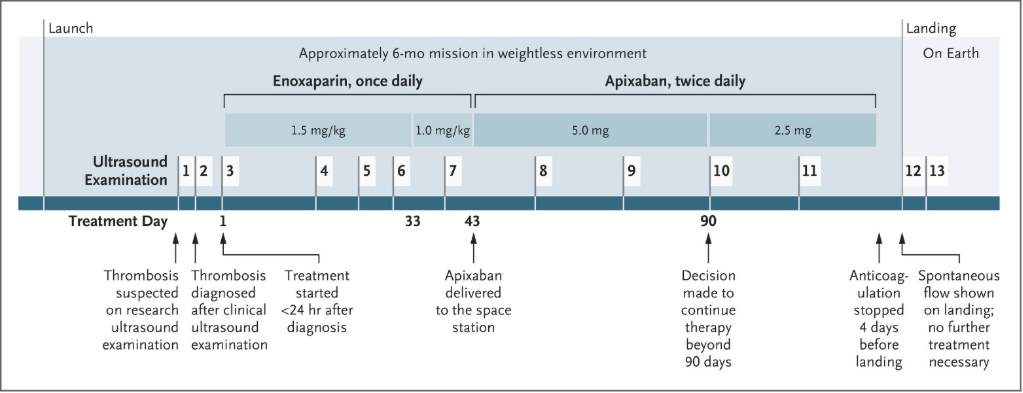
In 2020, the first case of spaceflight‑associated venous thrombosis was confirmed, revealing a previously unrecognized medical risk of microgravity. Two months into a long‑duration International Space Station (ISS) mission, as part of a vascular research study, an astronaut conducted a self-directed ultrasound exam and detected a potential clot. With guidance from two radiologists on Earth , they confirmed a deep vein thrombosis in the jugular vein of the neck (1. Aunon-Chancellor S et. al., N Engl J Med, 2020; 382(1): 89-90).
Timeline of Diagnosis and Treatment of Venous Thrombosis (Ref 1):
This event has implications for future space missions. On Earth, blood clots typically develop in the legs due to gravity and can sometimes travel to the lungs, causing a potentially fatal pulmonary embolism. In space, blood can shift towards the head and neck, increasing the likelihood of clots forming in the jugular vein. This isn’t alarming for short missions but could become significant during long-duration journeys, such as those planned under the Artemis Program and future missions to Mars.
HYPHEN BIOMED PRODUCT OF THE MONTH
Anti-Xa chromogenic method for the in vitro quantitative determination of Factor Xa (FXa) inhibitors, in human citrated plasma, using an automated method. This method is for monitoring patients on Heparin (UFH/LMWH), Arixtra@ Orgaran@ therapy and to monitor anticoagulant status, for patients on Apixaban, Rivaroxaban and Edoxaban.
This device of in vitro diagnostic use is intended for professional use in the laboratory.
Please consult the instructions for use.
221011 BIOPHEN™ Heparin LRT R1, R2: 4 x 7.5 mL
221013 BIOPHEN™ Heparin LRT R1, R2: 3 x 3 mL
221015 BIOPHEN™ Heparin LRT R1, R2: 4 x 5 mL
These are in vitro diagnostic devices intended for professional use in the laboratory.
FOLLOW THE SNAIL TRAIL to BETTER BLEEDING MANAGEMENT
We are all familiar with DOACs being small‑molecule drugs taken orally that directly inhibit factor Xa or thrombin, providing reliable long‑term anticoagulation but increase bleeding risk because they also impair normal haemostatic clotting. A recent paper has described a small snail‑derived compound CCG (Camaena cicatricosa glycosaminoglycan), as a heparin‑like glycosaminoglycan that works upstream by disrupting formation of the intrinsic FIXa–FVIIIa complex, selectively blocking pathological thrombosis in animal models without affecting normal bleeding control.
This compound is mechanistically more selective and promising for reduced bleeding. The future could only be a snail trail away. “A Snail Galactosed Glycosaminoglycan Inhibits Thrombosis without Affecting Hemostasis via Disrupting FIXa–FVIIIa Complex Generation” Lin L et.al., ACS Central Science, 2026, DOI: 10.1021/acscentsci.5c02230 https://www.news-medical.net/news/20260318/Snail-derived-compound-prevents-clots-while-preserving-normal-bleeding.aspx
Haematex is the only Australian distributor which carries out local R&D into coagulation diagnostics. When you purchase from us, a portion of profits go towards projects such as our own locally made DOAC-Stop™, and research on dRVVT and lupus anticoagulants. We hope this newsletter has been of interest, if you do not wish to receive future updates, please let us know.